

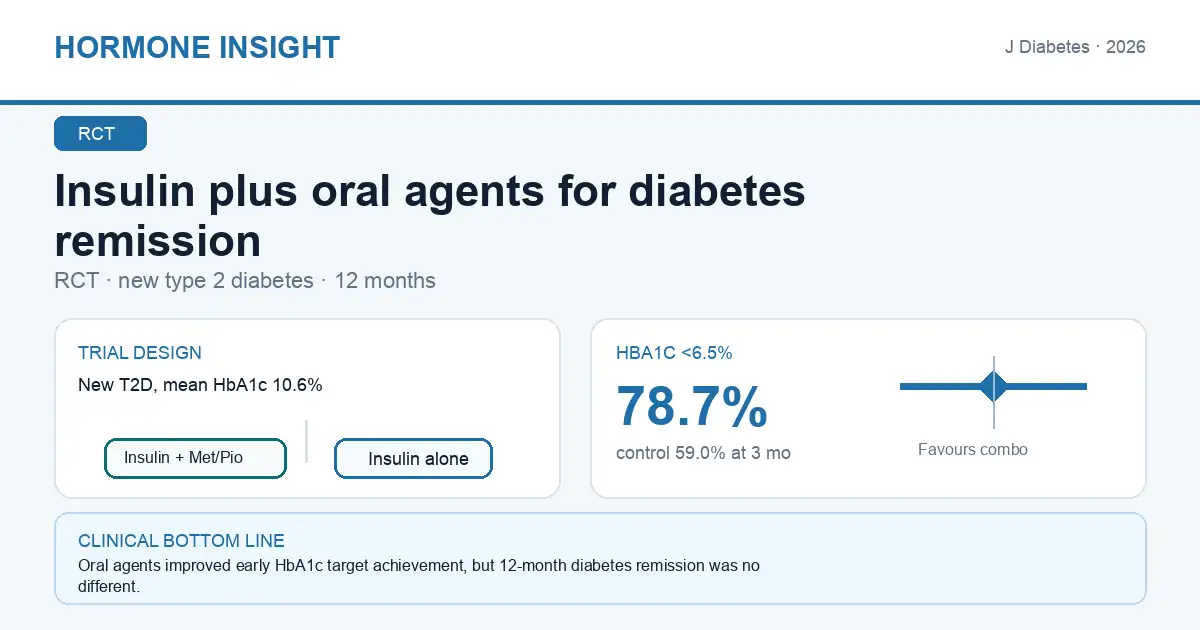
Summary: In a trial in newly diagnosed type 2 diabetes, adding oral agents to a short course of intensive insulin improved glucose control and beta-cell measures during and shortly after treatment, but did not improve the 12-month diabetes remission rate over intensive insulin alone.
PICO Summary
| Element | Detail |
|---|---|
| Population | 245 adults with newly diagnosed type 2 diabetes (mean HbA1c 10.6%); multicentre open-label randomised trial, China. |
| Intervention | Short-term intensive insulin therapy by continuous subcutaneous infusion plus either 90 days of metformin and pioglitazone, or 90 days of sitagliptin. |
| Comparison | Short-term intensive insulin therapy alone for 2 weeks. |
| Outcome | Both combination groups had lower insulin requirements, higher time in tight target range, and greater acute insulin response. At 3 months, more in the insulin-plus-metformin-pioglitazone group reached HbA1c <6.5% (78.7% vs 59.0%; adjusted p<0.05). However, 12-month remission rates did not differ among groups (p=0.972). |
Insulin plus oral agents for diabetes remission
RCT · new type 2 diabetes · 12 months
Adding oral agents to short-term intensive insulin raised the share reaching HbA1c below 6.5% at 3 months (78.7% vs 59.0%), but 12-month remission rates were no different (p=0.972).
Expert Commentary
This is an informative trial whose central message is a dissociation between short-term gain and durable benefit, and reading it correctly matters. The rationale for short-term intensive insulin in new type 2 diabetes is sound, relieving glucotoxicity to let beta cells recover, and adding oral agents did deliver real early advantages, lower insulin needs, more time in tight range, better acute insulin response, and more patients at HbA1c below 6.5% at three months. But the endpoint that counts, 12-month remission, was essentially identical across arms, with a p-value of 0.97, so combination therapy bought transient improvement without improving lasting remission. That fits the broader remission literature, including RISE, suggesting the window for beta-cell recovery is time-limited and that maintaining remission depends on factors beyond initial intensification. Limitations include the open-label design, a high mean baseline HbA1c of 10.6% that limits generalisability, non-standardised lifestyle support, an arbitrary 90-day oral duration, and possible underpowering for the remission comparison. Can I use this with my patients? Yes, to set expectations. Adding oral agents to intensive insulin can be considered when faster normalisation or lower insulin doses are desirable, but I would not promise better long-term remission from it, and would emphasise that sustained lifestyle change and weight management drive durable outcomes.
References
Ke W, Liu L, Zhang P, et al. Effects of short-term intensive insulin therapy combined with oral hypoglycemic agents for inducing remission in newly diagnosed type 2 diabetes mellitus: a randomized clinical trial. J Diabetes. 2026;18(1):e70187. doi:10.1111/1753-0407.70187